
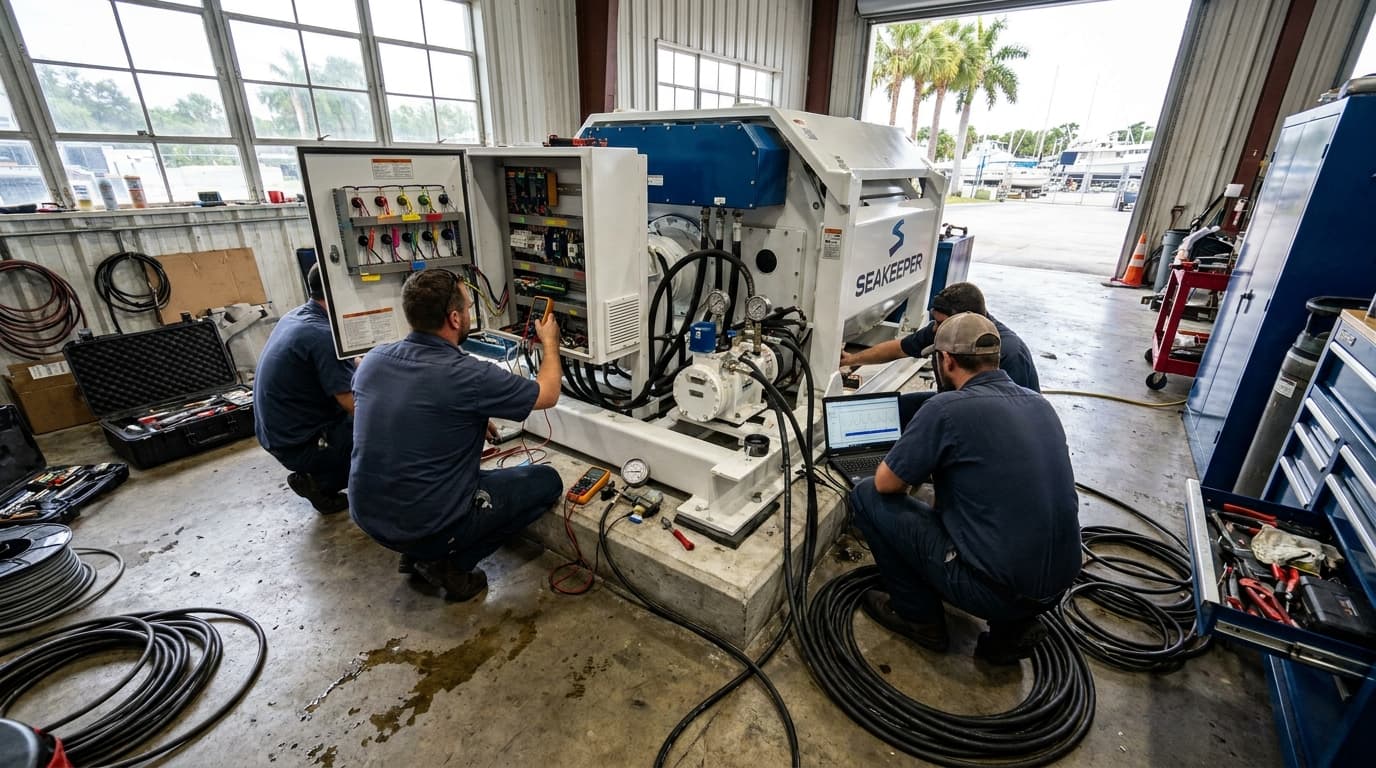
Five checks before a Seakeeper vacuum rebuild
The decision page is the rule for vacuum, seal, and network. This list is the order to use before you authorize a sphere. It is not a second kind of job.
The short version
Read the stabilizer display, not the pulsing box. Prove the alarm is still there. Prove seawater flow. Ask what the last haul did to the seals. If the local screen is alive and the helm page is dead, stop calling it vacuum.
| Check | Settles | Does not settle |
|---|---|---|
| 1. Alarm history on the stabilizer display | The manual will not clear an alarm from the ConnectBox alone. If the history does not say vacuum, you are not on a vacuum job. | A county spill fine or a noise limit |
| 2. Whether the condition is still present | Reset Alarm does nothing while the condition remains. A single spike that cleared when the enclosure cooled is not the same as pressure that keeps climbing. | A county spill fine or a noise limit |
| 3. Seawater flow at the outlet | The installation manual makes you prove flow before startup. No flow is a cooling fault wearing a vacuum costume. | A county spill fine or a noise limit |
| 4. What happened at the last haul | A seal disturbed on the hard can leak air after splash. That is still a dealer vacuum repair, but you tell them about the haul instead of a mystery underway failure. | A county spill fine or a noise limit |
| 5. A dark multifunction page with a live local display | That is a network fault. It belongs on the network list, not in a sphere crate. | A county spill fine or a noise limit |
How the five were ranked
Rank is the order that avoids opening the housing. The Seakeeper 1 operation manual (doc. 90520-1, 4 June 2020) puts identification on the display application and treats the ConnectBox as a presence light. That is why history is first. Flow is third because the installation manual (doc. 90519-1) requires it before startup, and a no-flow boat will alarm for reasons that are not a lost seal on the sphere. The haul question is fourth because it changes the story you tell the dealer, not because it replaces the history. The network check is last in this list and first in a different list: if it hits, you leave this page.
- Alarm history on the stabilizer display. The manual will not clear an alarm from the ConnectBox alone. If the history does not say vacuum, you are not on a vacuum job.
- Whether the condition is still present. Reset Alarm does nothing while the condition remains. A single spike that cleared when the enclosure cooled is not the same as pressure that keeps climbing.
- Seawater flow at the outlet. The installation manual makes you prove flow before startup. No flow is a cooling fault wearing a vacuum costume.
- What happened at the last haul. A seal disturbed on the hard can leak air after splash. That is still a dealer vacuum repair, but you tell them about the haul instead of a mystery underway failure.
- A dark multifunction page with a live local display. That is a network fault. It belongs on the network list, not in a sphere crate.
Model-specific pressure numbers are not copied here. A small-boat manual and a large-yacht sheet do not share one torr line. Read the sheet for the serial number on the unit. A number borrowed from a different model is how a healthy enclosure gets condemned.
Questions from the wheelhouse
Does a pulsing helm box mean the enclosure lost vacuum?
Not yet. The Seakeeper 1 operation manual says the ConnectBox only indicates that an alarm exists. The application on the 5-inch display or the multifunction display identifies it. Open the history before anyone schedules a sphere job.
Can a cooling fault look like a vacuum fault?
The controller locks the brake and shuts the drive on an alarm, and it stores history. A seawater side with no flow will put temperature in that history. The installation manual tells you to verify flow at the outlet before startup. Condemn the vacuum only after that flow is real and the history still names pressure.
Should the sphere come out on the first haul day?
Only after the alarm text says enclosure pressure and the cheaper checks are done. A network page that froze, or a fin seal that oiled the bilge, is a different housing. The rule page separates those three faults.
Do these five checks change in the Keys or in Broward?
The machine checks do not. The discharge and spill rules do, once oil is out. Use the county note for the berth after the alarm is named. Do not use a county spill sheet to decide whether the sphere lost vacuum.
Back to the rule before you book the haul. The callback for an in-spec Florida boat is below.