
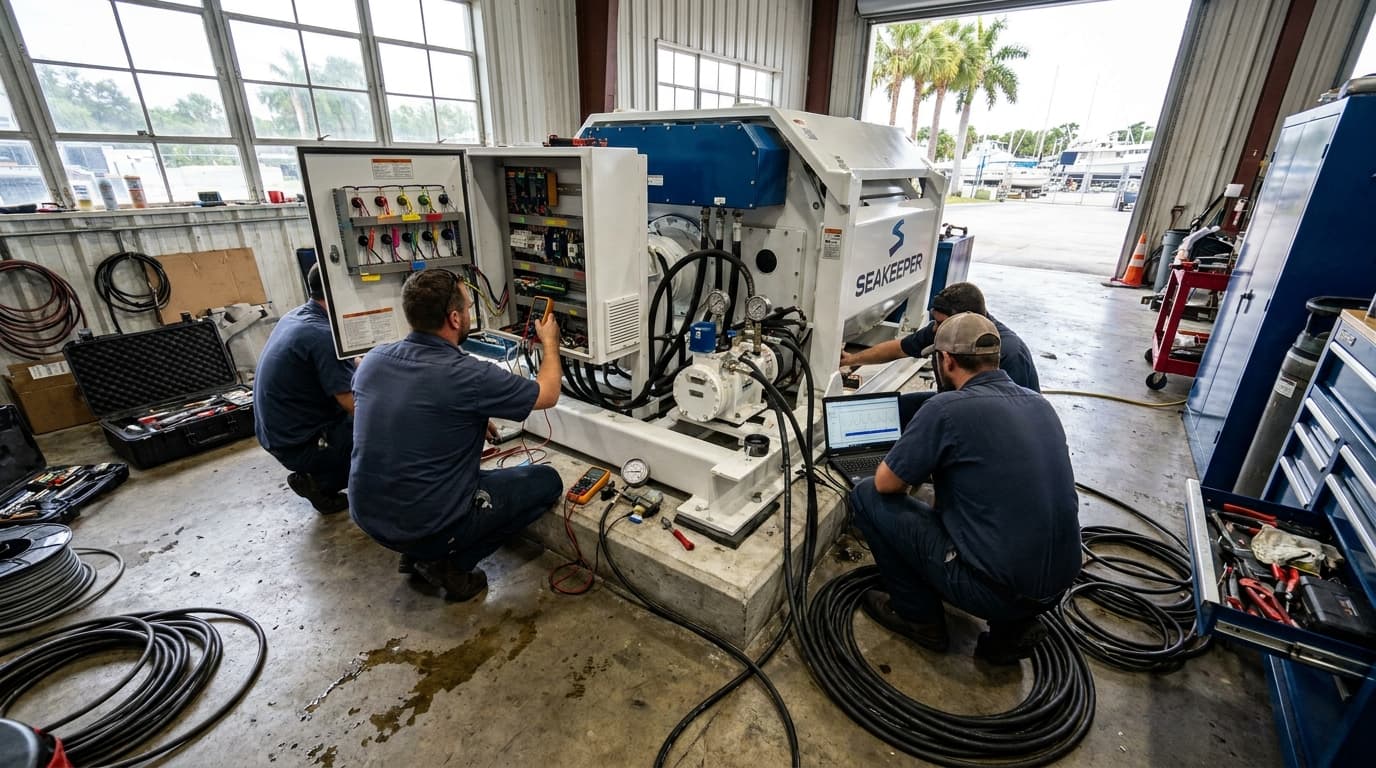
Separate the fault before anyone opens a housing
The useful question is which machine failed. A gyro stabilizer holds a flywheel under vacuum. The Seakeeper 2 operation manual (doc. 90489-2) says sensors measure vacuum pressure, and an alarm locks the brake and starts a coast-down. That is not a fin actuator. A hydraulic fin that weeps at the rod, or dumps oil into the bilge, is a seal and a containment problem. A blank page on the multifunction display, while the local controller still answers, is a network problem. Treat those as one ticket and the yard opens the wrong housing.
On an inspected small passenger vessel, 46 CFR 176.814 requires a steering test at each certification inspection. 46 CFR 61.20-1, amended 12 June 2024, puts the marine inspector on the steering gear and on the automatic-to-manual changeover. A gyro is not the steering gear. A shared hydraulic plant, or a control fault that blocks that changeover, is how a stabilizer call becomes an inspection delay. A private yacht is not on that clock.
| Fault | What you see | What stays closed | Where a local rule bites |
|---|---|---|---|
| Vacuum | Display alarm, flywheel will not hold speed, brake locks | The fin actuator | No spill rule until oil is actually in the bilge or on the dock |
| Seal | Oil at the wiper, header tank down, sheen if it reached the bilge | The sphere | Broward yard BMP, river-yard permit, city storm drain, or sanctuary bilge rule |
| Network | Helm page blank, local controller still responds | Both housings, until the wire is proved | Sector Jacksonville changeover test, if the boat is certificated there |
The state rule is the inspection clock, not a fee schedule
No public schedule sets a price for this diagnostic. Do not treat a rumor of a yard day-rate as a rule. What is published is the inspection interval above, and the local documents on the county pages: a spill threshold, a permit, a decibel table, a sanctuary discharge ban, a city fine. Those documents are why a Fort Lauderdale yard and a St. Petersburg berth are not the same note.
Sector lines are in 33 CFR part 3, subpart 3.35. An inspected boat is examined by the office that holds the zone. The county notes say which office and which spill or noise rule applies.

What changes from one berth to the next
| Berth | Document that makes the page | What the neighbor does not share |
|---|---|---|
| Fort Lauderdale yards | Broward’s marine-facility BMP names hydraulic oil and a 10-gallon spill report. That rule is the yard, not the city next door. | Broward yards |
| Miami River yards | A commercial facility on the river needs a Miami-Dade marine operating permit. A house in Miami does not make this page true. | River yards |
| Town of Palm Beach | Ordinance 008-2022 sets different night limits north and south of Worth Avenue. West Palm Beach does not use that map. | Island docks |
| Monroe County | Sanctuary rules allow cooling water and strike oily bilge pumping out of the exception. Broward’s yard BMP is a different document. | Keys waters |
| St. Petersburg | City Code § 27-431 bans petroleum in public waters, with a $500 fine. The county stormwater article does not cover this city. | City berths |
| Duval County | Sector Jacksonville’s zone stops at 28°N. The marine inspector tests steering gear on a clock a private yacht does not share. | Inspected commercial |
Checklist before you ask for the call
- Photograph the alarm text on the stabilizer display, including the history page.
- Say whether oil is on a rod, in a tank sight glass, or in the bilge. Quantity matters once a county threshold applies.
- Confirm the berth is one of the six notes above, not a house and not Georgia, Alabama, or the Bahamas.
- On a certificated boat, say whether the steering changeover still works with the stabilizer controller dark.
- Leave the sphere closed until the alarm names vacuum, and leave the actuator closed until oil is the evidence.
Notes a chief engineer searches
The rule for the diagnostic itself is the state page for the three faults. These three notes stay on that job:
- Five checks before a vacuum rebuild
- Four seal failures that look like a helm fault
- Six network faults at the stabilizer helm
County and zone notes are indexed on Counties.1234
Questions from the wheelhouse
Does a private yacht sit on the Coast Guard steering-inspection clock?
No. 46 CFR 61.20-1 sends a marine inspector to the steering gear on certificated vessels. A private yacht with no certificate is not on that clock. The alarm is still a fault. It is not an inspection item until the boat is certificated.
Can a vacuum alarm and a fin-seal leak be booked as one job?
No. A vacuum alarm is enclosure pressure and a brake lock. A fin-seal leak is oil at a rod or in the bilge. Name the alarm text before anyone opens a housing.
Do you come to a house dock or a boat that never leaves a residence?
No. The callback stops for a house, a condo, or a boat kept only at a residence, and for Georgia, Alabama, the Bahamas, or a request that names only Miami, Tampa, or Jacksonville.
What should I have in front of me before the call?
The alarm line, the length, the model, and the berth: a Broward yard, a Miami River facility, a Town of Palm Beach dock, Monroe County waters, a St. Petersburg city berth, or an inspected boat in the Sector Jacksonville zone.
Sources
- U.S. Coast Guard. “46 CFR 61.20-1 — Steering gear.” Amended by USCG-2020-0634, 89 FR 50189, 12 June 2024. Accessed 8 October 2026. ecfr.gov.
- U.S. Coast Guard. “46 CFR part 176 — Inspection and Certification,” including § 176.814 steering systems. Accessed 8 October 2026. ecfr.gov.
- Seakeeper. “Seakeeper 2 Operation Manual,” doc. 90489-2. September 2018. Accessed 8 October 2026. seakeeper.com.
- U.S. Coast Guard. “33 CFR part 3, subpart 3.35 — USCG Southeast District sector zones.” Accessed 8 October 2026. ecfr.gov.